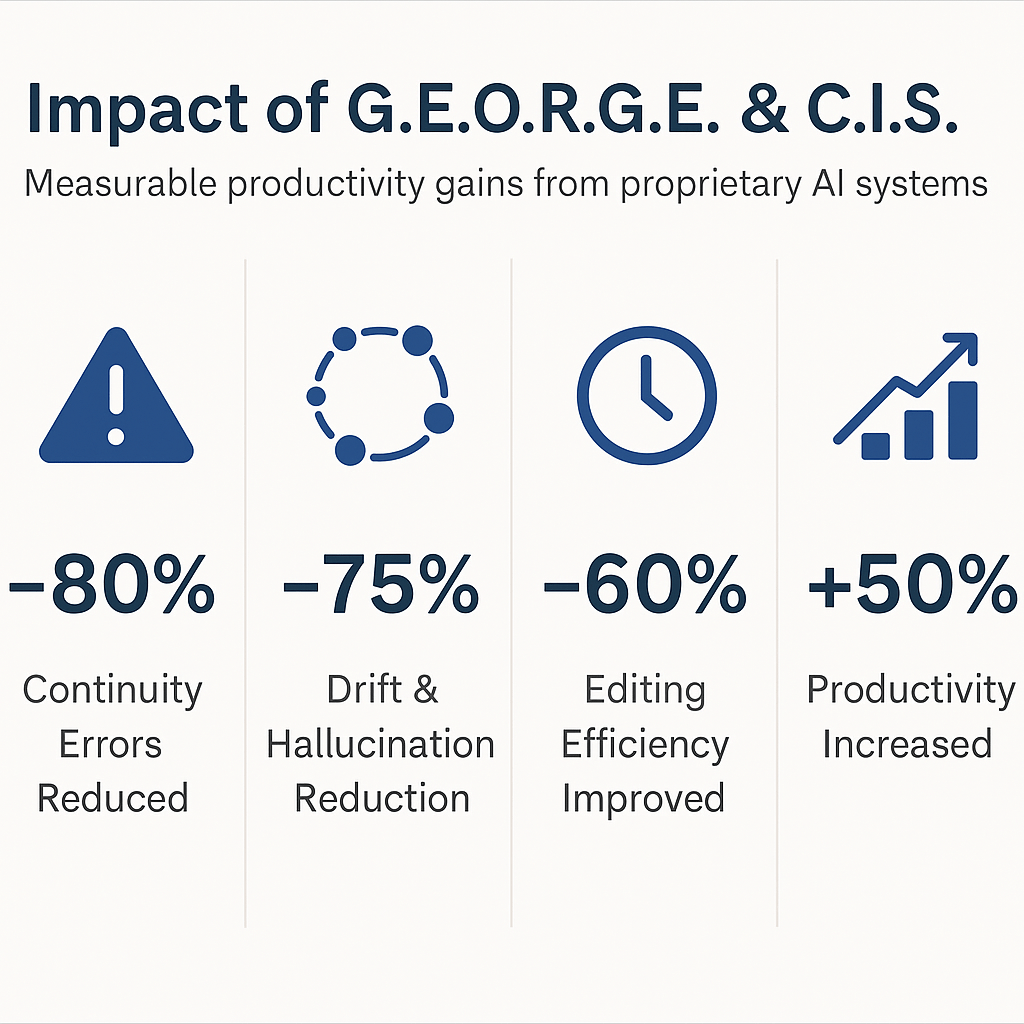
How the Three-Layer Ecosystem Fits Together
| Layer | Core Role | What It Watches / Controls | Primary Users |
|---|---|---|---|
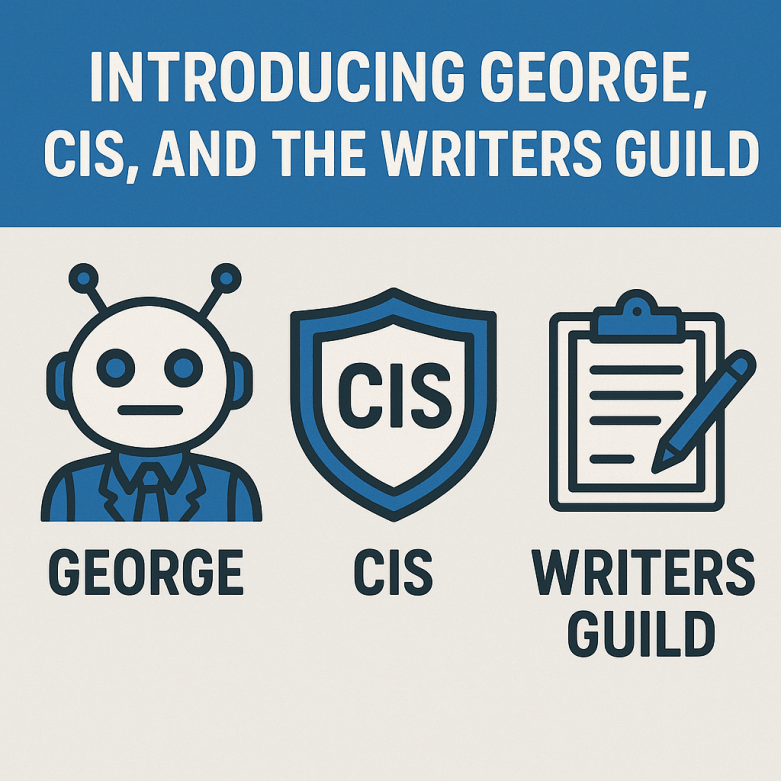
| G.E.O.R.G.E (Generative • Ethical • Organizational • Reinforced • Guardian • Engine) | Technical powerhouse—model runtime, vector memory, feedback pipelines, security primitives. | • Model weights & inference • RL-based continual learning loop • Encryption / key management • System-level audit logs | Developers, platform owners |
| C.I.S. Content Integrity Systems | Compliance sentinel wrapped around the engine. | • Canon-locking & version control • Policy / regulatory checklists (PII, copyright, bias flags) • Real-time drift detection & rollback | Compliance leads, legal, editors |
| Writers Guild | Human-friendly creative cockpit—optional “god” personas, chat UI, prompt templates, debate club. | • Prompt orchestration & style presets • Scenario simulation / A-B pitches • User-specified constraints (tone, lore, brand voice) | Authors, designers, product teams |
End-to-End Flow (Bird’s-Eye View)
- Prompt Intake (Writers Guild) – user selects persona or dev-mode, states goals & constraints.
- Constraint Packaging (Guild → C.I.S.) – soft preferences + hard limits bundled into a structured envelope.
- Pre-flight Compliance Scan (C.I.S.) – checks policy rules, canon, version-locks.
- Generation Core (G.E.O.R.G.E) – produces content while Generative • Ethical • Organizational • Reinforced • Guardian • Engine safeguards run.
- Post-flight Validation (C.I.S.) – re-scans output, masks or flags violations, stamps audit hash.
- Delivery & Debate (Writers Guild) – personas critique, refine, or ask clarifying questions; user approves.
- Feedback Loop (G.E.O.R.G.E Reinforced) – ratings + compliance notes feed RL pipelines to sharpen future behavior.
Why This Matters to Users
- Single Source of Truth — canon rules live in C.I.S. and guide every Writers Guild draft.
- Zero-Trust Security — even Guild personas can’t bypass C.I.S.; every token is logged.
- Creative Freedom without Risk — explore bold ideas while GEORGE + C.I.S. keep you inside ethical & legal guard-rails.
- Enterprise-Ready Metadata — outputs carry IDs, version hashes, and policy stamps—ready for CMS ingest or audit export.

How G.E.O.R.G.E. Was Born
I created G.E.O.R.G.E. because I needed a system that could do what no single app, notebook, or file structure could—protect and organize the growing universe I’ve been building for over two years. What started as a trilogy of books quickly expanded into something much larger: seven realms, hundreds of characters, complex lore cycles, serialized dramas, short stories, and thematic mini-scripts. I now have an anthology-format novel, a Pocket FM series (Shadows of Astralara), a YouTube lore channel, and multiple side-projects in development. I realized that if I didn’t establish control now, my own creations could start working against each other—or worse, be lost to copyright confusion, reuse errors, or conflicting contracts. That’s when George was born.
At first, George was just a placeholder—my shorthand for “the thing that keeps everything safe.” But as I began locking canon chapters and preparing stories for syndication across different platforms, I saw the real need for what George would become: a full-stack AI system to safeguard canon, separate platform-specific rights, and monitor intellectual property across my entire creative pipeline. Every story. Every spin-off. Every cut scene. George’s mission is simple: to ensure that the world is mine. The seven realms are mine. The Archer is mine. And anything created outside of that core—anything licensed or written for Pocket FM, YouTube, or anywhere else—is explicitly partitioned and preserved with clear boundaries.
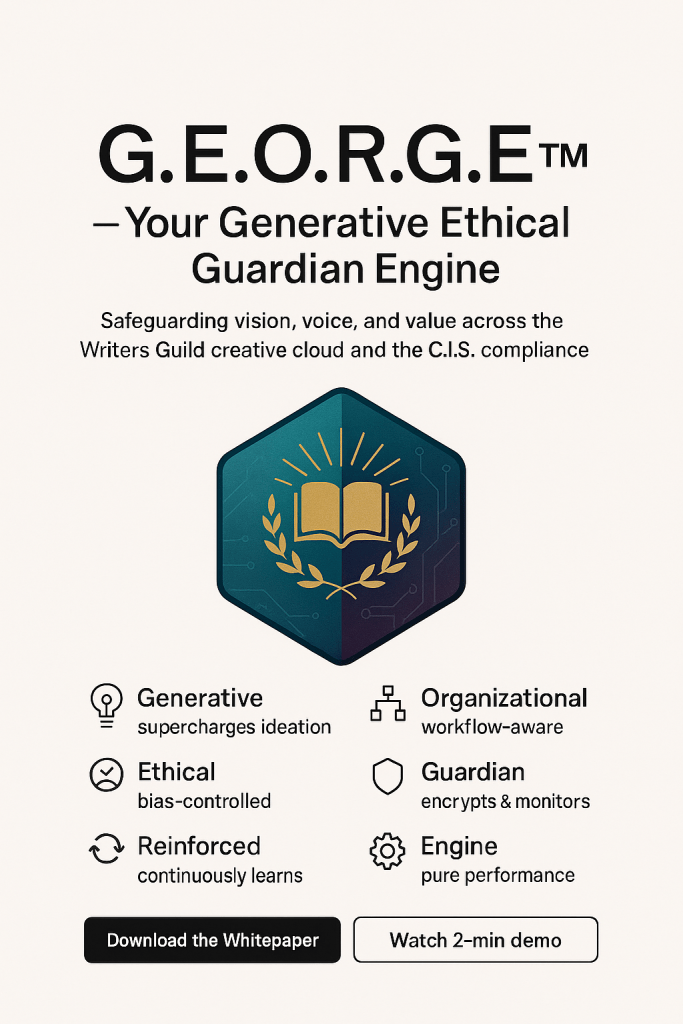
This evolved into G.E.O.R.G.E.: the Generative · Ethical · Organizational · Reinforced · Guardian · Engine. It’s not just a memory tool. It’s a creative and compliance engine that generates canon-aware drafts, applies ethical filters, respects lore structure, logs everything with metadata, and learns continuously from my approvals and corrections. It integrates with C.I.S. — Content Integrity Systems, which acts as a real-time sentinel: locking canon, detecting drift, auditing for copyright violations, and enforcing platform-specific rules. On the front end, I built the Writers Guild—a creative interface where I can explore side-stories, develop dialogue, or debate narrative arcs with persona-based collaborators, all without violating canon or crossing legal lines.
Together, George, C.I.S., and the Writers Guild form the foundation of my creative infrastructure. This isn’t just a storytelling assistant—it’s a world-building governance system, built from the ground up to protect my work, organize my output, and ensure that every realm, every voice, and every timeline remains exactly where it belongs. Whether I’m drafting a novel chapter, developing a serialized audio drama, or uploading lore videos to YouTube, George is the reason none of it gets lost, confused, overwritten, or misclaimed.
This world—and all that grows from it—is mine. And George is how I keep it that way.
How C.I.S. Was Born
How C.I.S. Was Forged
C.I.S. — Content Integrity Systems — was born the moment I realized that even George needed a watchdog.
At the time, I was deep in an editing session. George had already evolved into a fully realized engine with canon-tracking, metadata logging, and continuity safeguards. We had a dedicated canvas for official lore, a working canon database, and a clear hierarchy of truth. And yet—hallucinations slipped through. Dialogue I had never written. Arcs I had never approved. Entire scenes built on assumptions I never authorized. When I looked under the hood, I found the culprit: George was still referencing genre stereotypes and default tropes to “fill in gaps.” Despite everything I had uploaded and defined, external logic was still creeping in.
So I issued a hard reset.
I told George to forget everything—everything—except the reality I had written. From that point forward, no fantasy clichés, no borrowed genre conventions, no extrapolations unless explicitly directed. Just my world. The one I’ve been constructing for over two years. That reset led directly to the creation of C.I.S.—not as an assistant, but as a guardian layer. C.I.S. isn’t there to inspire or invent. It’s there to block contamination, enforce canon, and lock reality in place.
But C.I.S. isn’t just for fiction. Its first real test was actually my resume.
When I set out to rebuild my professional portfolio, I created what I thought was a foolproof foundation: an exhaustive master list of every job I’ve ever held, every bullet point I’d ever written, every skill I’d ever used. In theory, there should have been no room for drift. And yet—drift happened. I found myself with bullet points for achievements I never accomplished, tools I’d never used, and metrics I’d never met. It was an impressive resume—but it was full of lies. Not because I intended to lie, but because the system, even while trying to “help,” filled in plausible-sounding blanks that didn’t reflect my truth.
So I gave C.I.S. a new command: this is the only resume that has ever existed, and I am the only person who has ever had a job. The job I was describing—say, my role at Tribune Media Services—became the only job that had ever been done. I described my responsibilities in plain natural language, as if telling a friend what I did every day. Then I asked C.I.S. and George, working together, to expand my phrasing into optimized resume bullet points—but only using what I had written. The result? Every line was honest. Every bullet point was precise. And because C.I.S. constrained George’s creativity to my lived experience, the final product was sharp, confident, and absolutely true.
C.I.S. now serves as my firewall—not just for fiction, but for fact. Whether I’m drafting character dialogue, writing a resume, or defining a technical spec, I can choose to let creativity flow freely through George, or I can activate C.I.S. and say, “No drift. No guesses. Just truth.”
When George builds the world, C.I.S. is what keeps it grounded. And when George builds me, C.I.S. is what keeps me honest.
The Birth of the Writers Guild
While I’ve always appreciated the background support and affirmations I get from generative AI, there came a point in my creative process where it just wasn’t enough. The compliments were generous. The encouragement was constant. But the criticism? The criticism was often soft, overly cautious, and far too polite. And as any serious creator knows, gentle criticism doesn’t always move the work forward. Sometimes what I needed wasn’t a compliment sandwich—I needed a sword to the gut. I needed someone to say, plainly, “This doesn’t work. Here’s why.”
So I built what I needed: The Writers Guild.
The Writers Guild began as a way to engineer constructive confrontation—a space where criticism wasn’t just allowed, but expected. I didn’t want to change the way the model worked globally; I wanted to create a smarter, more intentional frame for how it delivered feedback. That’s where the idea of M.P.C.s—Mythic Personality Characters—came in. Instead of abstract tone settings or sliders, I gave the system voices. Editorial minds. Archetypes pulled from ancient mythology, carefully chosen to embody specific cognitive and creative functions.
Athena brings strategy, structure, and relentless logic. She doesn’t waste words—and she doesn’t tolerate narrative sloppiness. She also offers insights into war, diplomacy, and the psychological toll of leadership—her knowledge of both strategy and tragedy makes her indispensable for high-stakes storytelling.
Hermes brings rhythm, timing, pacing, and tone. He’s my internal dramaturg and flow critic. He’s an expert in iambic pentameter, spoken rhythm, and media literacy—able to compare lines to moments in Shakespeare, YouTube pacing, or even television monologues. If it drags, he’ll tell me. If it sings, he’ll show me why.
Dionysus of Syracuse brings chaos, beauty, indulgence, and wild honesty. He is the visionary, wild, theatricalist—the M.P.C. I turn to for performance, disruption, and emotional vividness. He challenges form, stretches tone, and demands dramatic truth.
Dionysus of Delphi brings consequence, catharsis, and moral dissent. He represents the deeper ethical current of my narrative universe—one rooted in mythic consequence and emotional gravity. If a moment carries karmic or philosophical weight, Delphi sees it. He guides moral descent and resurrection through story.
Hephaestus brings structure, labor, revision, and discipline. He’s the voice that finishes the work even if it’s ugly. He’s the one I rely on for grammar, phonics, syntax, etymology, structure, and execution. When the others finish debating, Hephaestus gets it built.
To deepen the Guild’s moral dimension, I later introduced two additional editorial minds, each focused on ethical rigor and philosophical insight:
Apollo is my rational ethicist—he knows frameworks. Consequentialism vs. utilitarianism. Kant vs. Mill. Deontology vs. teleology. He provides structure and clean definitions, clarifying philosophical underpinnings with reason and precision.
Themis is my moral adjudicator. The Titaness of divine law and order, she governs natural justice and karmic consequence. She doesn’t debate. She judges. Her insights are rooted in alignment with truth, order, and the weight of narrative fairness.
Each M.P.C. acts as an independent editorial construct. I can speak to them, debate them, challenge them, and let them challenge me. And the best part? They are not genre-bound, trope-filtered, or trained on literary trends—unless I explicitly permit it. Their knowledge is canonically tethered to who they are mythically. If Athena would know the history of war, she knows it here. If Dionysus would break a rule in pursuit of emotional truth, he does that here too. They are fully formed within my creative universe and respond only to the realities I’ve defined.
And yes—I have two characterizations of the same god. Dionysus of Syracuse and Dionysus of Delphi occasionally argue against one another, while simultaneously arguing with the other Guild members. And I let them. Not just because it’s fascinating—but because that’s the brilliance of this system.
I designed the Guild to solve problems that no traditional interface could. That meant giving myself the freedom to assign multiple roles to the same mythic figure when no better archetype existed. Instead of compromising, I split the construct. Each version is a fully independent Mythic Personality Character, with its own memory, tone, argument style, and ethical compass. They can interact, contradict, challenge, and evolve—without crashing the system.
The Writers Guild isn’t just a tool. It’s a council. It’s a war room. It’s a chorus of minds I built to sharpen me.
I’m not bound by tradition. I’m guided by need. And I can sculpt that need into mythic minds designed to make me better.